



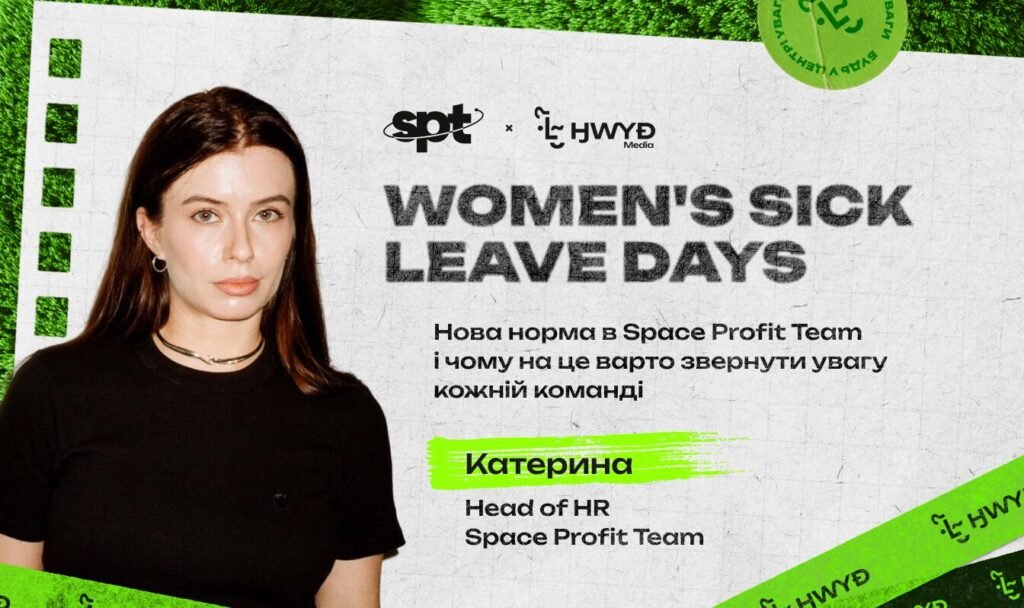
Women's Sick Leave Days. A new norm in Space Profit Team and why every team should pay attention to it.
Just a few years ago, the affiliate niche was almost entirely male — and the issue of women's health at work simply didn't come up because there was no one to raise it. But the situation has changed: there are more and more women on teams, they hold key positions, and things that could be ignored before can no longer be overlooked.
Most women have worked through severe pain at least once in their lives — not because they couldn't stop, but because stopping was inconvenient. It's easier to sit at a laptop, pretend everything is fine, and not explain a reason to the team that it's still somehow not customary to talk about.
This is an unspoken norm that almost no one questions. SPT decided to question it — and introduced Women’s Sick Leave Days, separate additional days for conditions related to women's health. 12 days a year for recovery, one per month, without a medical certificate or unnecessary explanations. A day when every woman can feel cared for and understand that her health will not stand in the way of her work.
As far as we know, no affiliate team in Ukraine has officially introduced this practice yet.
We spoke with Katya, Head of HR at SPT — about why the seemingly simple solution remains the exception, and what it actually reveals about the team's attitude toward people.
HWYD: Let's start broader: has the niche itself changed in recent years?
Katya: Absolutely. Previously, there were few women in media buying, and the whole culture was built around that—no one simply thought about such things because there was no reason to. Now everything is different: there are more and more women on teams, they hold key roles, and pretending that their conditions do not exist is no longer «neutrality,» it is falling behind. We want to be a team that notices such changes before they become a problem, rather than catching up with them later.
HWYD: Where did you first see this practice and how much time passed from the idea to actual implementation?
Katya: I first saw it in international markets — there, it's long been considered standard practice rather than something groundbreaking. It didn't take long to put the idea into practice — when there is an understanding of why and internal support, it doesn't require years of discussion.
HWYD: Is this a matter of care for you?
Katya: I don't like the word «care,» it's worn out. For me, it's a matter of honesty. If a person forces themselves to do something for part of the month, that is already a reality, it already exists. The question is only whether we pretend it doesn't exist, or acknowledge it and offer a reasonable solution. Ignoring a problem is also a decision. Just a bad one.
How does that shape your approach as an HR leader?
Katya: I always see the person first, and the professional second. Not a «resource,» not a «unit» that has to deliver results no matter what—a person with context, a history, and a state of mind. And my task is to build an environment where that context doesn't need to be hidden. HR is usually perceived as corporate parties and onboarding. In reality, it is about the team's cultural code: how people interact, whether they trust each other, and whether they can be themselves without fear that it will be used against them.
HWYD: Why is this important not only for the individual, but also for the team?
Katya: Because a person who is struggling will still do the tasks — they will just do them worse. And there is a second part, less obvious: when people know they'll be supported without being made to feel uncomfortable about it, they don't start looking for somewhere else to go. This is directly about whether people stay with you or you are constantly filling the same positions. For me, this is not a «good initiative.» It is normal management, which for some reason is still considered something special.
HWYD: Why should such a practice be introduced not only by you?
Katya: Because this is not about a privilege for a specific team, it is about the level of standards. We are used to taking pride in things that should actually be the norm. I want this step to stop being news — so that in a few years people look back at it and don't understand how it could have been any other way. For now, it is an exception. I would like it to become the rule.
HWYD: What would you say to teams thinking about something similar?
Katya: Don't do it just for show or for a nice post. Do it if you are truly ready to see people as people—every day, not just on the day of the announcement. Because policy without this stance behind it is just a line in a document. But with it, it's the reason why people stay.
Want to join Space Profit Team / start a traffic partnership / arrange a media collaboration?
Everything is gathered in one place — go to Space Profit Team bot.
Follow the news and team life in Instagram Space Profit Team.
The team shares its own insights and market and niche perspective in his TG channel.